
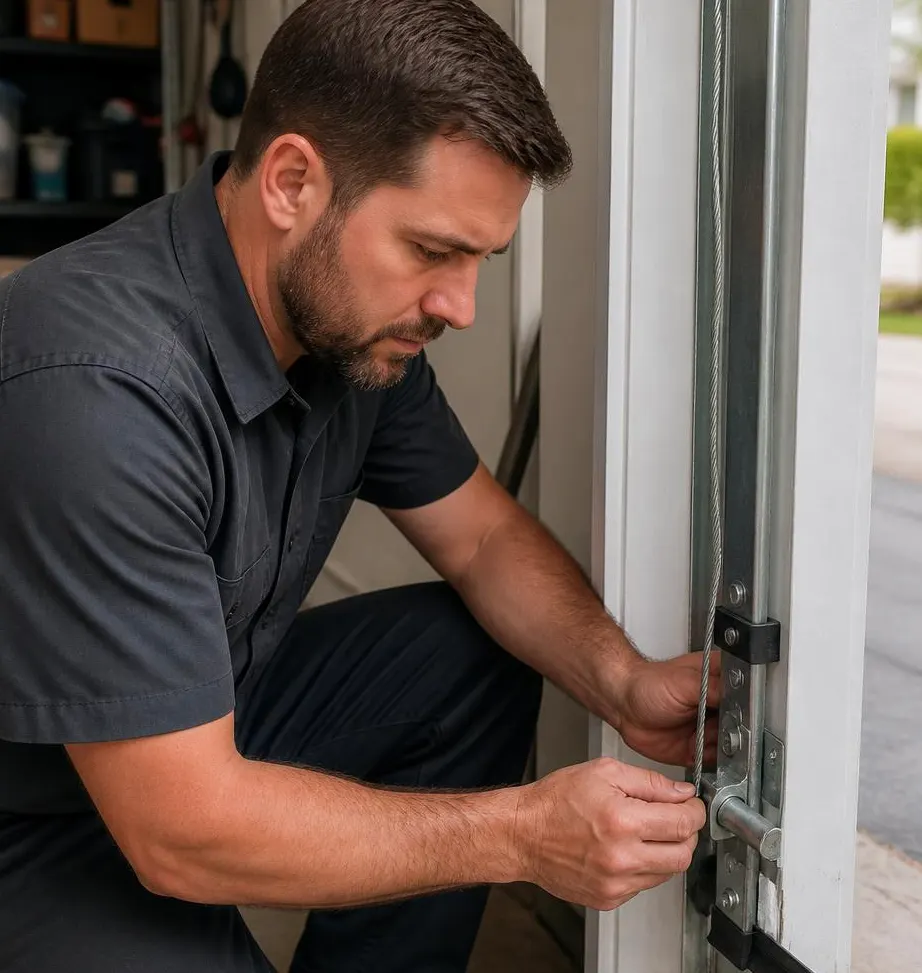
The Mistake Most People Make First
Most homeowners wait for the obvious sign: a visible gap in the spring coil, or the door refusing to budge. It's a tempting thing to wait for, because the spring is mounted up above the door where you never look, and the opener does all the lifting work for you. The door still goes up and down every single day, right up until the moment it doesn't. There's no dashboard light, no warning beep. So people assume that if the door is moving, the spring must be fine. In reality, a spring under stress gives off several smaller signals weeks or months before it actually breaks, and most of them show up in how the door behaves, not in how the spring looks.
Walk Your Garage Door Through This Checklist
Grab a flashlight and give yourself ten minutes. Go through these in order, with the door closed and the opener disconnected for the ones that call for it.
1. Look for a visible gap in the torsion spring coil
If you have a torsion spring (the thick spring mounted horizontally above the door, on a metal shaft), look for a clean separation between two coils, almost like the spring has been cut. This usually means it's already broken, not just wearing out. If you see this, do not operate the door at all — the stored tension can release suddenly.
2. Do the manual lift test
With the opener disconnected (pull the red release cord), lift the door by hand to about waist height and let go. A door with healthy springs should stay roughly where you left it. If it drops on its own, or shoots upward, the springs are no longer carrying their share of the door's weight. This is one of the most reliable early warnings there is.
3. Listen for a change in the opener's effort
If the opener motor sounds like it's working harder than it used to, or the door noticeably slows down partway through its travel, the springs are likely compensating less and the motor is picking up the slack. Openers aren't built to lift a door's full weight long-term; this strain shortens the life of the opener too.
4. Check for fraying or loose cables (extension spring systems)
If your garage uses extension springs (the long, stretched springs running along the upper tracks, usually with a safety cable through the center), inspect the cables for fraying, kinks, or slack. A loose or frayed cable often means the spring it's attached to has already stretched past its usable range.
5. Look for rust or pitting on the coils
Citrus County's humidity, afternoon downpours, and salt-tinged air for homes closer to the coast all accelerate corrosion on exposed metal. Rust doesn't just look bad — it eats into the spring's surface, creating weak points where it's more likely to snap under tension. A spring with visible orange or flaking rust is wearing out faster than a clean one, even if it still looks intact.
6. Pay attention to new noises
A spring nearing the end of its life often starts making sounds it didn't before: a grinding noise as the coils rub against each other unevenly, a popping sound during operation, or a loud bang when the door closes. These sounds usually mean the coil spacing has changed or a coil has shifted on the shaft.
7. Watch how the door closes
A door that slams the last foot instead of settling into place, or one that seems to drift back open slightly after closing, is often fighting an imbalance between the spring tension and the door's actual weight. This also shows up as uneven closing speed from one side to the other.
8. Check for one side riding higher than the other
Stand back and watch the door open and close. If one side visibly lags or sits higher than the other at any point, one spring (on two-spring systems) is likely weaker than its pair. Mismatched spring tension puts extra strain on the tracks, rollers, and the weaker spring itself, speeding up its failure.
9. Know the rough lifespan you're working with
Torsion springs are generally rated by cycle count, and many residential springs are built for somewhere around 10,000 cycles — which for an average household works out to roughly 7 to 10 years, depending on how often the door is used. If you don't know how old your springs are and the door has been in use for most of a decade, treat items 1 through 8 above as more urgent, not less.
When to Call Lecanto Door & Opener
If your manual lift test showed the door dropping or shooting up, if you're seeing rust pitting or a coil gap, or if one side of the door is visibly out of balance, it's time to get it looked at rather than waiting. Our Garage Door Spring Repair service covers torsion and extension spring replacement, matched to your door's actual weight and cycle needs rather than guessed at. If your springs test out fine but the door is due for a once-over before hurricane season winds and humidity put more strain on it, our Garage Door Maintenance & Tune-Up checks spring tension, cables, rollers, and hardware in one visit so small issues don't turn into a stuck door or a snapped spring down the road.
If any of these checklist items sound familiar, call Lecanto Door & Opener today and we'll get a technician out to inspect your springs before they fail on their own schedule instead of yours.